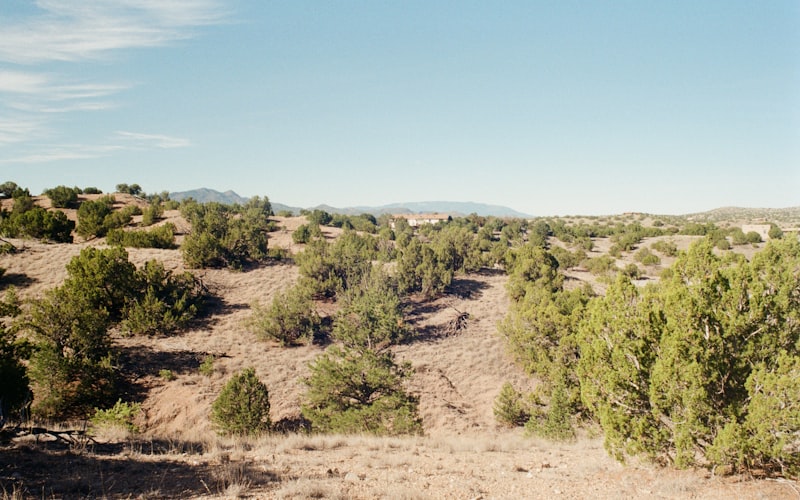
In 1929, Georgia O'Keeffe visited New Mexico for the first time and spent the summer painting in Taos. She returned almost every year afterward and eventually moved to the high desert permanently in 1949, settling in the remote village of Abiquiú. The landscape she found, the particular quality of light, the bleached animal skulls, the red and ochre cliffs of the Piedra Lumbre, became the subject of some of the most recognizable paintings in American art history. To visit O'Keeffe country is to move through that landscape and understand, viscerally, what she saw and why she never left.
The Georgia O'Keeffe Museum, Santa Fe
The logical starting point for any O'Keeffe pilgrimage is the Georgia O'Keeffe Museum on Johnson Street in downtown Santa Fe, a block from the Plaza. The museum holds the world's largest collection of her work, over 3,000 objects including paintings, drawings, sculptures, and archival materials, and the permanent galleries offer the fullest possible survey of her development from early abstractions through the New Mexico desert years to the large-scale sky and cloud paintings of her final decades.
The museum mounts four to five special exhibitions per year, often pairing O'Keeffe with artists who influenced or were influenced by her, Alfred Stieglitz, Ansel Adams, Arthur Dove. The gift shop is one of the best in Santa Fe: serious art books, quality reproductions, and items that stop well short of kitsch. Allow two hours minimum for the museum itself. For the most immersive experience, buy the combined museum-and-home-tour ticket that includes the Abiquiú property visit.
Abiquiú: O'Keeffe's Home
From Santa Fe, take US-84 north through the Española Valley and into the red rock country that opens up past Hernández. The drive takes about an hour. Abiquiú sits on a mesa above the Chama River, a small village of adobe houses clustered around a central plaza. O'Keeffe's home here, a large compound she purchased in 1945 and spent decades renovating, is maintained by the Georgia O'Keeffe Museum and open for tours from April through November.
Tours of the Abiquiú home are intimate and limited to a handful of visitors at a time. You move through the rooms where she worked and lived, the studio with its north-facing windows and the view of the Piedra Lumbre she painted so many times, the kitchen garden, the patio with the door that appears in so many of her paintings, with a guide who knows the property and the life deeply. The door that fascinated her, the flat-topped Cerro Pedernal visible on the horizon, the quality of the light at different hours: being in the physical space of the paintings changes how you see them.
Reservations are essential and should be made weeks in advance; tours sell out consistently, especially from May through October. Book at okeeffemuseum.org.
Ghost Ranch
Eight miles north of Abiquiú on US-84 is Ghost Ranch, the 21,000-acre conference and retreat center where O'Keeffe owned a small house from 1940 onward. She spent summers here for decades, painting the cliffs of the Piedra Lumbre from her property. The ranch offers hiking trails that pass directly through the landscape she painted, the Red Hills, Cerro Pedernal, the Cliffs of Shining Stone. A small on-site museum provides context for her time there, including photographs and archival materials.
The views from the mesa trails at Ghost Ranch are extraordinary, arguably the most directly O'Keeffe-legible landscape you can access without a private tour. On clear days, Cerro Pedernal, the flat-topped peak she depicted repeatedly and claimed as her own ("God told me if I painted it enough, I could have it"), dominates the southern horizon exactly as it does in her paintings.
The Drive and the Landscape
The drive from Santa Fe to Abiquiú on US-84 is itself part of the O'Keeffe experience. The highway passes through the Española Valley, then climbs through volcanic rock formations and red earth that grow more dramatic with each mile. The village of Hernández, north of Española, is where Ansel Adams made his celebrated photograph "Moonrise, Hernandez, New Mexico" in 1941, on a pull-off that is still there. The Piedra Lumbre opens up past Abiquiú, revealing the full expanse of red and ochre cliffs that furnished O'Keeffe with decades of subject matter.
In autumn, late September through October, the cottonwoods along the Chama River turn gold, and the red cliffs take on an intensified warmth in the lower sun angle. This is the single best time to visit O'Keeffe country, when the landscape most closely matches what you see in the autumn paintings.
Canyon Road's O'Keeffe Legacy
Back in Santa Fe, Canyon Road galleries continue to show work in the tradition O'Keeffe helped define, large-format landscape painting, abstracted desert forms, the bold flat color fields that her New Mexico years pioneered. Gerald Peters Gallery and Nedra Matteucci Galleries both maintain deep inventories of historical Southwest painting that provide essential context for her achievement. The New Mexico Museum of Art on the Plaza, with its permanent survey of 20th-century New Mexico art, places O'Keeffe in the full context of the artists who worked alongside her, the Taos Society painters, the modernists who came to Santa Fe in the 1920s and 1930s, the mid-century abstractionists she influenced.
Practical Notes
- O'Keeffe Museum home tours book months in advance for summer; check okeeffemuseum.org in February for spring availability.
- Ghost Ranch (ghostranch.org) is open year-round; the hiking trails are accessible without a reservation, though the property charges a day-use fee.
- The best time to visit Abiquiú is late September through October, when the cottonwoods turn gold and the light matches what you see in the autumn paintings.
- Combine the O'Keeffe sites with Ojo Caliente Mineral Springs (30 minutes south of Abiquiú) for a full day in the region.
- The combined drive from Santa Fe to Abiquiú and Ghost Ranch and back is about three hours of driving; plan for a full day with the home tour.


