Marfa, Texas sits at 4,688 feet in the high Chihuahuan Desert, three hours from the nearest major airport and roughly equidistant from nowhere in particular. That isolation was a feature, not a flaw, for Donald Judd, who arrived in 1971 looking for a place to realize his art on a scale and permanence that New York could never provide. What he built, and what has grown up around it, makes Marfa one of the most improbable and consequential art destinations in the world.
The Chinati Foundation: Judd's Permanent Statement
The Chinati Foundation is the reason most serious art travelers come to Marfa. Judd acquired a decommissioned U.S. Army base called Fort D.A. Russell and spent two decades converting its artillery sheds, warehouses, and open land into permanent installations of singular ambition. His own work fills two massive artillery sheds: 100 untitled works in mill aluminum, each one unique, each occupying the same volume, all arranged in precise rows under the same desert light that shifts across them hour by hour. There is nothing else like it.
The Chinati also permanently houses works by Dan Flavin, whose colored fluorescent lights fill six former barracks buildings in a sequence that rewards slow walking, and John Wesley, Ilya Kabakov, and Claes Oldenburg and Coosje van Bruggen. Tours must be booked in advance, walk-ins are not accommodated, and they run Thursday through Monday. Plan for a full morning or afternoon.
The Judd Foundation
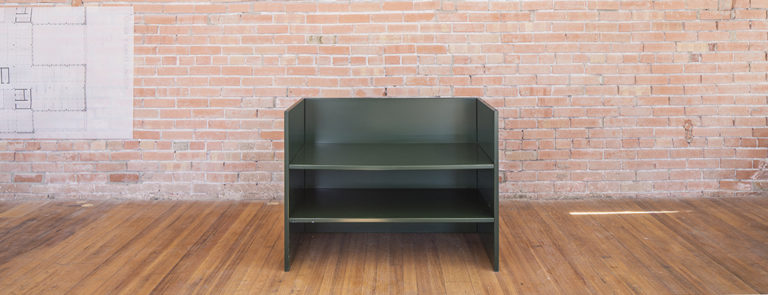
Separate from the Chinati, the Judd Foundation maintains two properties in downtown Marfa: the Block, a complex of studios and living spaces that Judd converted and filled with his furniture designs and personal art collection, and the Archives, which houses his library and papers. Guided tours of the Block offer an intimate view of how Judd lived and worked, the furniture he designed, the Navajo rugs he collected, the arrangement of objects he considered as carefully as any sculpture. These tours also fill quickly; booking weeks ahead is advisable during peak season (March through November).
The Gallery Scene That Followed
Judd's presence drew artists, and the artists drew galleries. Marfa's commercial gallery scene is small but edited to a fine point, no tourist schlock, almost no cowboy art. The quality of work is consistently high.
Ballroom Marfa is the town's leading contemporary arts nonprofit, operating out of a converted ballroom and producing ambitious exhibitions, public projects, and the occasional sound installation that plays across the desert at night. Programming here consistently punches at a major-city level.
Galleri Urbane brings a cosmopolitan perspective, showing established and emerging artists in a beautifully spare space near the Chinati offices. The roster includes artists working in painting, sculpture, and mixed media, and the gallery makes a point of representing voices from outside the usual art-world centers.
Wrong Marfa occupies a restored adobe building and focuses on younger, often irreverent contemporary work that leans into the absurdist humor that has always shadowed Marfa's art-world earnestness. It's the gallery most likely to surprise you.
Prada Marfa and the Open Desert
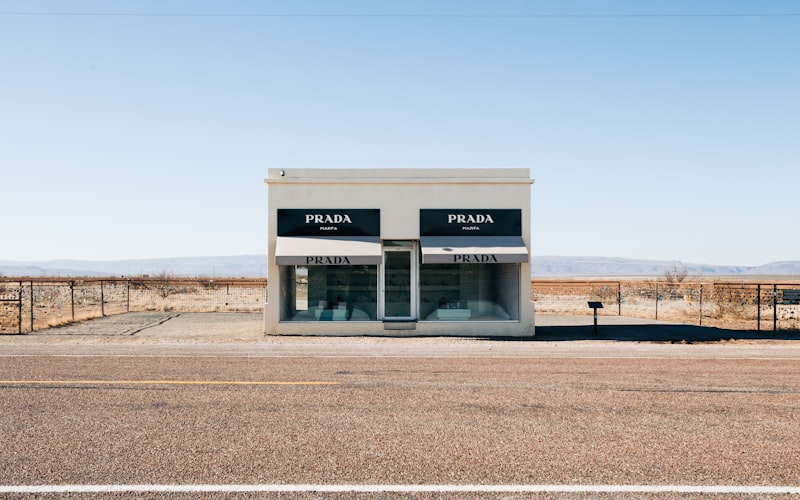
Thirty-seven miles northwest of town on US-90, the Prada Marfa sculpture by Elmgreen and Dragset stands in open desert with no explanatory signage. It looks exactly like a Prada boutique, glass storefront, lit display windows, actual Prada merchandise sealed inside, but it is a permanent artwork, never open for business, slowly weathering into the landscape. It has become one of the most photographed art objects in the Southwest, though the drive there and the silence around it are the real experience.
When to Go
Marfa's high season runs from March through May and September through November, when temperatures are bearable and the art calendar is fullest. The Marfa Myths music and arts festival in April draws an international crowd. Summer is brutal (100°F days are common) and many galleries reduce hours or close entirely. Winter is cold but quiet, and the Chinati Foundation's open house weekend in October is the single best moment to be in Marfa, when the foundation opens works not usually accessible to the public and the entire art community converges.
Practical Notes
- Book Chinati Foundation tours at chinati.org well in advance, especially for spring and fall.
- The Judd Foundation Block tours are limited to small groups; reserve at juddfoundation.org.
- Marfa has no chain hotels. El Cosmico, the Thunderbird, and Saint George Hall are the main options, all fill up fast during festival weekends.
- Bring cash; many establishments do not accept cards.
- The drive from El Paso takes about two hours on US-90; from San Antonio, three and a half hours on I-10 west.