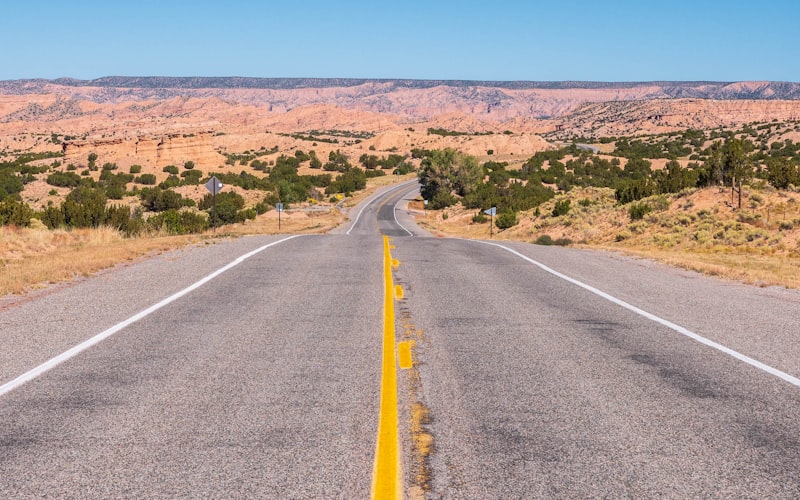
The 70-mile stretch of highway between Santa Fe and Taos is one of the great art road trips in the United States. Two routes connect the cities: the Low Road (NM-68 through the Rio Grande Gorge) and the High Road (NM-503 to NM-76 to NM-518 through the Sangre de Cristo foothills). Together they form a loop that passes through a landscape of extraordinary beauty and a succession of historic villages that have been producing art, pottery, weaving, woodcarving, painting, for centuries. Plan on two full days minimum to do it justice.
Santa Fe: The Starting Point
Begin in Santa Fe and give yourself a full day before heading north. Canyon Road in the morning, the New Mexico Museum of Art on the Plaza in the afternoon. The museum provides essential historical context, Taos Society of Artists paintings, early 20th-century New Mexico photography, mid-century modernism, for everything you'll encounter on the corridor. The Georgia O'Keeffe Museum, a block from the Plaza, is a mandatory stop if you're seeing New Mexico for the first time. An evening opening on Canyon Road, typically on Friday, gives you the social dimension of the Santa Fe art world, artists present, wine poured, conversations that continue into the dinner hour.
The High Road North
The High Road to Taos leaves Santa Fe heading east on NM-503, then climbs into the Sangre de Cristo foothills through a succession of small villages that were established by Spanish settlers in the 17th and 18th centuries and retain much of their original character.
Chimayó is the first significant stop, known for the Santuario de Chimayó (a pilgrimage church said to have healing properties) and for the Ortega family weaving tradition. Ortega's Weaving Shop has operated continuously since 1900 and remains one of the finest sources for traditional Rio Grande weaving in the state, the geometric patterns and natural wool dyes are immediately recognizable as a distinct New Mexico tradition.
Córdova, a few miles further, is the woodcarving capital of New Mexico. The village's tradition of carved santos and animals, maintained by families including the López and Montoya lineages, produces work that ranges from simple folk art to sophisticated sculpture. Several carvers sell directly from their homes; look for signs on the road.
Truchas sits at nearly 8,000 feet on a ridge with views of the Truchas Peaks and the Rio Grande valley below. The village has attracted artists since the 1960s and now hosts a cluster of studios and galleries alongside its historic church and acequia system. Robert Redford filmed The Milagro Beanfield War here in 1988, and the setting has barely changed.
The Low Road: Rio Grande Gorge
The Low Road (NM-68) follows the Rio Grande through a dramatic gorge between Española and Taos, one of the most scenic drives in New Mexico, cutting through layers of basalt and limestone that tell 65 million years of geological history. This is the faster route and the one to take if you're returning from Taos to Santa Fe, the light coming down the gorge in the late afternoon is extraordinary.
Taos and Its Institutions
Taos rewards at least a full day. The Taos Historic Museums operate the Blumenschein, Couse, and Sharp homes, the actual studios where the founding artists of the Taos Society of Artists worked, now preserved with their furniture, paintings, and personal objects. The Harwood Museum of Art, operated by the University of New Mexico, holds the finest collection of Taos art outside of a major city museum, including the permanent Agnes Martin gallery. Taos Pueblo, open most days to visitors, is the living center of the Taos Pueblo people's cultural life and the most important Indigenous site in the corridor.
Beyond the Obvious
The D.H. Lawrence Ranch, 20 miles north of Taos on NM-522, is maintained by the University of New Mexico as a study center. Lawrence lived here in the 1920s and wrote about the landscape and the Pueblo world with a vividness that explains why this corridor has attracted writers and artists for a century. The Millicent Rogers Museum, four miles north of the Taos Plaza, holds an extraordinary private collection of Pueblo pottery, Diné weaving, and New Mexico santos. The Ojo Caliente Mineral Springs, halfway between Santa Fe and Taos on US-285, offers a natural hot springs experience that pairs well with the rigors of gallery-going.
Practical Notes
- The High Road takes about two and a half hours without stops; allow a full day with village stops.
- Ortega's Weaving Shop in Chimayó is open daily 9am–5pm; ortegasweaving.com.
- Taos Pueblo charges an admission fee; closed during ceremonial periods (call ahead: taospueblo.com).
- Accommodations in Taos book quickly in summer and fall; El Monte Sagrado and the Historic Taos Inn are the most atmospheric options.
- The loop is best driven northbound on the High Road and southbound on the Low Road, to catch the afternoon light in the gorge.