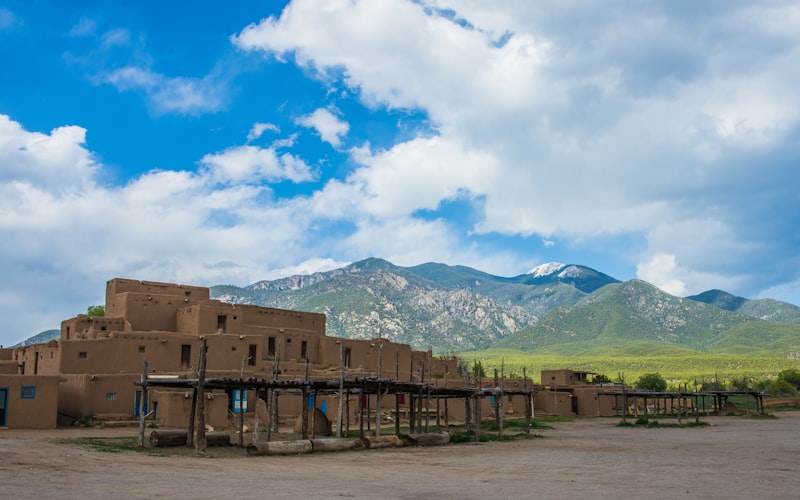
Taos has been a destination for artists since 1898, when painters Bert Geer Phillips and Ernest Blumenschein stopped here when a wagon wheel broke on the road from Denver. What they found, Pueblo people living in a multi-story adobe complex that had been continuously inhabited for nearly a thousand years, surrounded by mountains and high desert that had no equivalent in European-trained eyes, changed both men permanently. Within a decade they had founded the Taos Society of Artists, and the town's identity as an art colony was fixed.
The Historic Art Colony
The Taos Society of Artists produced some of the most celebrated American paintings of the early 20th century, and the institutions that grew from that era remain central to the town's cultural identity. The Taos Historic Museums operate three properties directly connected to the founding artists: the Ernest Blumenschein Home and Museum, the E.I. Couse Home and Studio, and the Joseph Henry Sharp Home and Studio. Together they constitute an extraordinary resource for understanding how the colony actually lived and worked.
The Harwood Museum of Art, operated by the University of New Mexico, houses one of the finest collections of Taos art in any institution, a permanent survey running from the Society of Artists through the mid-century modernists (including Agnes Martin, who spent her final decades in Taos) and into the present. The Agnes Martin gallery alone, with seven large paintings displayed in natural light, is worth the visit.
Kit Carson Road and the Gallery District
Taos's commercial gallery district runs along Kit Carson Road and the blocks immediately surrounding the historic Plaza. The concentration of galleries is not as dense as Canyon Road in Santa Fe, but the quality is consistently high and the atmosphere considerably less pressurized.
Taos Gallery on Kit Carson Road is one of the oldest operating galleries in town, with a broad survey of contemporary Southwestern painting and sculpture across a series of connected rooms. The gallery's deep ties to the community mean its roster includes artists who have been part of the Taos scene for decades alongside newer arrivals.
Lumina Gallery focuses on fine art photography with a strong emphasis on the Southwest landscape tradition, work in the lineage of Ansel Adams and Laura Gilpin but made by contemporary photographers who have found their own relationship to the region. The printing quality and framing are exceptional.
Wilder Nightingale Fine Art takes a more selective approach, representing a curated roster of painters whose work engages with the Taos landscape in ways that go beyond conventional Western subject matter. The gallery has a particular strength in large-format work.
Taos Pueblo
No art visit to Taos is complete without Taos Pueblo, the UNESCO World Heritage Site that has been continuously inhabited for nearly a millennium. The Pueblo is home to many of the region's finest Indigenous artists, potters, jewelers, painters, and weavers, who sell work directly from their homes and studios within the Pueblo walls. This is one of the few places in the Southwest where collectors can buy directly from Native artists in the context of their living community. The Pueblo is open to visitors most days (closures occur during ceremonial periods; check taospueblo.com before visiting).
The Millicent Rogers Museum
Four miles north of Taos Plaza on NM-522, the Millicent Rogers Museum houses the personal collection of the Standard Oil heiress and fashion icon who moved to Taos in 1947 and spent the remaining six years of her life acquiring Pueblo pottery, Diné weaving, and New Mexico santos at a level of connoisseurship that has rarely been equaled. The collection, now over 7,000 objects, is displayed in a purpose-built adobe museum and provides essential context for anyone interested in the Indigenous art traditions of the Southwest.
Beyond the Galleries
The D.H. Lawrence Ranch, 20 miles north of Taos in the mountains above San Cristóbal, is maintained by the University of New Mexico as a study center. Lawrence lived here intermittently in the 1920s and wrote about the Taos landscape and Pueblo culture with a vividness that helps explain the town's hold on creative people. The ranch is open to visitors on a limited basis.
Practical Notes
- Gallery hours in Taos are generally 10am–5pm, Tuesday through Sunday; many close on Monday.
- The Taos Fall Arts Festival in September is the best single moment to be in town, galleries open studios, auctions take place, and the entire art community is accessible.
- Taos Pueblo charges an admission fee and camera fee; closures for ceremonial periods are not always announced in advance, so call ahead.
- The drive from Santa Fe via the High Road to Taos (NM-503 to NM-76 to NM-518) is 90 minutes but passes through a series of historic Pueblo and Spanish colonial villages that are destinations in themselves.


