Tucson is the most underrated art city in the American Southwest. While Santa Fe and Scottsdale receive the bulk of the region's art-world attention, Tucson has quietly built one of the most authentic and diverse creative communities in the desert, shaped by its proximity to the Mexican border, its large Indigenous population, its university, and a desert landscape that has attracted artists who prefer solitude and low overhead to scene-making and celebrity. The result is a city where serious work gets made without the pressure of a tourist market, and where collectors who take the trouble to find it often discover something genuinely original.
The Downtown Arts District
Tucson's gallery scene is centered on the downtown arts district, which runs along Congress Street and the surrounding blocks and has been the site of significant revitalization over the past decade. The monthly First Thursdays Art Walk, held on the first Thursday of each month from 5 to 8pm, brings together galleries, studios, and alternative spaces across the district.
Davis Dominguez Gallery is the anchor of the Tucson commercial scene, representing a broad roster of regional and national artists across painting, sculpture, photography, and printmaking. The gallery has operated continuously for over three decades and has built genuine relationships with the artists it represents, the kind of institutional memory that makes conversation with staff unusually informative. Programming is ambitious and the quality consistent.
Etherton Gallery specializes in fine art photography with particular depth in the American Southwest and the borderlands, documentary and fine art work that engages with the landscape and communities of the region. The gallery has been instrumental in establishing the careers of several major photographers and maintains an archive of historical Southwest photography that is consulted by institutions and collectors worldwide.
The University of Arizona and the Museum Scene
The University of Arizona gives Tucson an institutional infrastructure that few cities of its size can match. The University of Arizona Museum of Art (UAMA) holds a collection of over 7,000 works spanning the 15th century to the present, with particular strengths in European Old Masters, American modernism, and 20th-century works on paper. Admission is free for Pima County residents and UA students; nominal for others.
The Center for Creative Photography, also on the UA campus, is one of the world's great photography archives, holding the estates of Ansel Adams, Wynn Bullock, Harry Callahan, and dozens of other major photographers. The public galleries show rotating exhibitions from the archive, and the research facilities are open to scholars. For photography collectors and enthusiasts, the CCP is a mandatory stop.
The Tucson Museum of Art downtown focuses on Western American art and the art of the American West's Indigenous and Hispanic cultures, with a permanent collection that provides essential regional context. The museum's campus includes several historic adobe structures dating to the Spanish colonial period.
The Tohono O'odham and Indigenous Art Traditions
Tucson sits within the traditional territory of the Tohono O'odham Nation, whose reservation, the second-largest in the United States by land area, lies to the west of the city. The Tohono O'odham have maintained distinctive basket-weaving and pottery traditions for centuries, and contemporary artists from the Nation work in both traditional and contemporary modes. The Tohono Chul cultural garden and gallery in northern Tucson shows work by Tohono O'odham artists alongside other Sonoran Desert artists and provides educational context for the Indigenous cultures of the region.
The Fourth Avenue Arts Scene
Tucson's Fourth Avenue commercial district, running from downtown north to the University, is the city's bohemian spine, lined with vintage shops, restaurants, and a scattering of gallery spaces that tend toward the experimental and affordable. The Dinnerware Artspace, an artist-run nonprofit that has operated since 1979, is the most historically significant alternative space in Tucson, with a programming history that has included artists who went on to major national careers. The space operates on a shoestring and shows work that the commercial galleries won't touch, which is exactly the point.
The Sonoran Desert as Subject
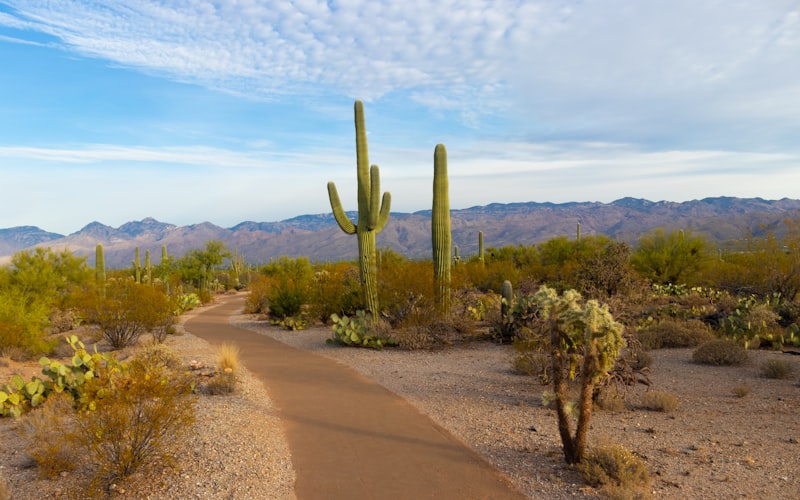
The desert around Tucson, the Sonoran Desert, the most biologically diverse desert in North America, has shaped the visual culture of this region as completely as any geographic feature shapes any art scene. Saguaro cacti, monsoon storms, the Santa Catalina Mountains turning pink at dusk, the spare and severe beauty of the desert floor: these are the subjects that Tucson's artists return to repeatedly and that distinguish the city's visual culture from the cooler, drier desert of northern New Mexico.
Practical Notes
- First Thursdays Art Walk runs monthly, 5–8pm; check tucsonfirstthursdays.com for participating venues.
- The Center for Creative Photography is open Monday through Friday, 9am–5pm, and select Saturdays; ccp.arizona.edu.
- The Tucson Museum of Art is free on the first Sunday of each month.
- Spring (February–April) is the best time to visit, the desert is in bloom, temperatures are ideal, and the cultural calendar is full. The Tucson Gem and Mineral Show in February draws an enormous crowd and overlaps with significant gallery activity.
- The drive from Phoenix takes about two hours on I-10; from Sedona, about three hours.